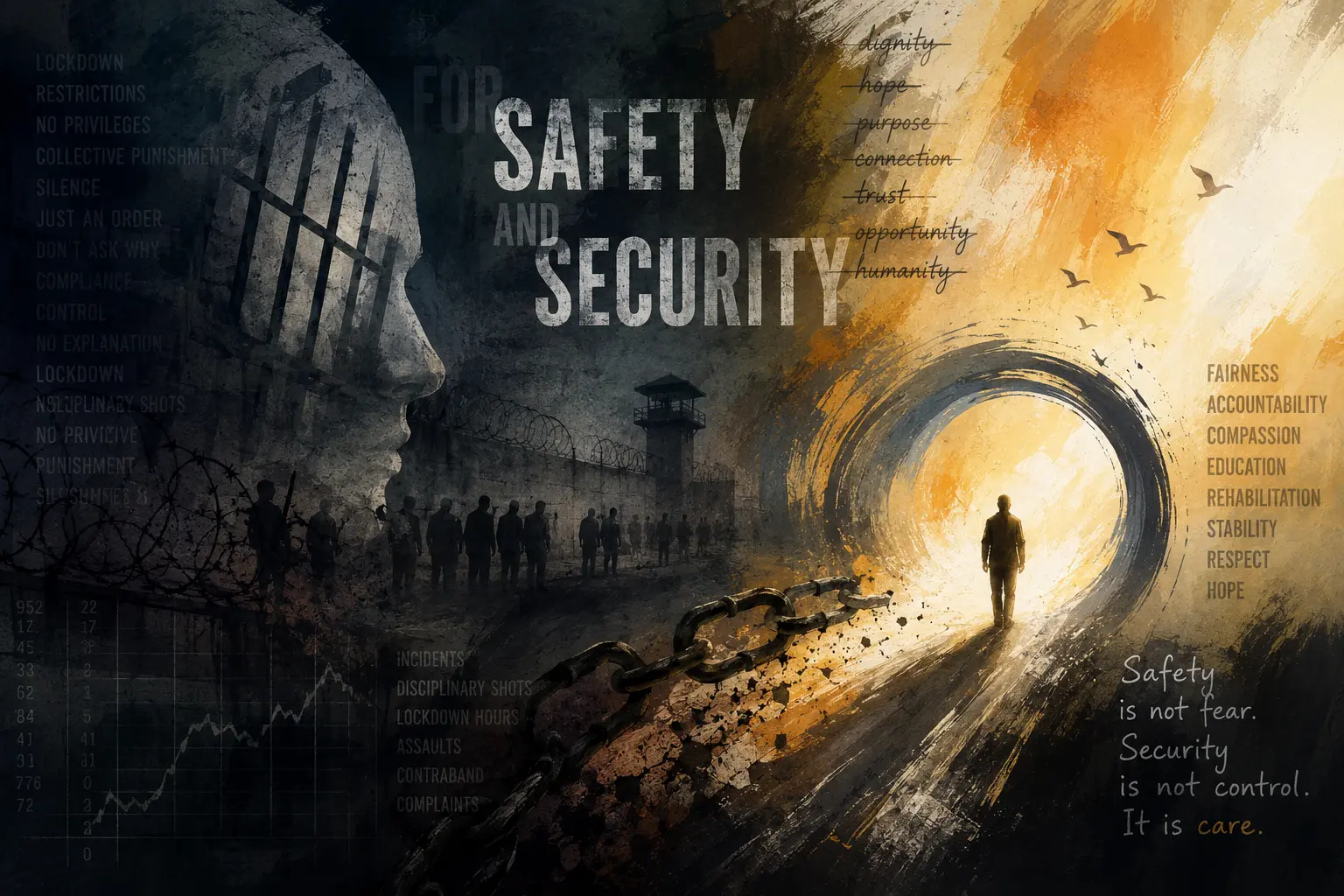
FOR SAFETY AND SECURITY
November 20, 2025•Published Essays
SAFETY AND SECURITY IN THE FEDERAL BUREAU OF PRISONS
The Most Misused Phrase in Modern Corrections
By Gideon Lock, The Prisoner Philosopher
The order came before breakfast. “Seal the windows,” the captain said, his tone leaving no room for questions. “For safety and security.” By midmorning, a maintenance crew was outside the building, drills whining as they fastened steel bars across the windows to keep them from opening more than an inch. The air smelled faintly of dust and heated metal. By nightfall, every cell felt hotter, heavier. Men pressed wet towels against their faces just to breathe. No riot had occurred. No contraband had been found. The change came because someone higher up decided that open windows were a “risk.” There was no hearing, no warning—just an order, justified by four words that need no defense inside prison walls. For safety and security. It’s a phrase every prisoner knows by heart. It can justify nearly anything: a lockdown, a mail restriction, a canceled visit. It ends conversations before they begin.
The Language of Control
Outside these walls, “safety and security” sound like virtues. Inside, they’re often code for don’t ask why. The phrase appears hundreds of times in Bureau of Prisons policy statements. It gives staff discretion so broad that explanation becomes optional. When a warden cancels recreation, suspends classes, or eliminates religious services “for safety and security,” there is no review process—only compliance. Former correctional officer and writer Ted Conover, who worked at Sing Sing and later wrote Newjack: Guarding Sing Sing, noted that in institutions built on control, talk of safety often becomes talk of power. Every directive, no matter how arbitrary, can be shielded behind those words. The result is what sociologists call administrative absolutism—a culture where authority no longer needs evidence, only repetition. Within this logic, to question the phrase is to challenge the entire structure of command.
The Revolving Door of Authority
Every prison has its own rhythm. Nothing throws it off like a change in command. When a new warden arrives, both staff and inmates brace for impact. In a culture obsessed with control, stability is mistaken for complacency—and every incoming administrator feels pressure to leave a mark. Wardens at federal institutions often rotate every few years, their transfers driven by promotions or political shifts. Each new regime comes with a slogan: Zero Tolerance for Contraband, Renewed Focus on Safety and Security, Institutional Reset. But under those banners, the same story plays out. Recreation schedules are rewritten. Mail limits change. Phone access tightens. Programs that once steadied the daily rhythm vanish overnight. Every new policy is explained as a “proactive step” toward safety—though few survive the next turnover. Custody staff often learn to wait it out. “Give it a year,” one veteran officer told me. “The next boss’ll undo it anyway.”
But prisoners